Are you in scope?
Find out in four questions — then produce the paperwork regulators ask for first.
In force across all 27 EU countries since 28 June 2025.
Enforcement has started
It already applies. And it's being enforced.
If you sell online to EU consumers, the Act probably reaches you — even if your business is outside the EU. It follows the market, not your address.
Retailers received legal notices. A court ordered one to make its website and app accessible within six months, with daily fines if it didn't.
Competitors are sending warning letters under competition law. No regulator needed.
The regulator has been opening cases focused on e-commerce since October 2025.
Formal information requests have gone to online stores — including ones based abroad.
When a regulator gets in touch, the first request is paperwork: your accessibility statement and the assessment behind it. Do you have both today?
What's inside
Five tools. One folder. Works offline.
Used in order, they take you from "does this apply to me?" to having the documents on file.
STEP 1
Are you actually in scope?
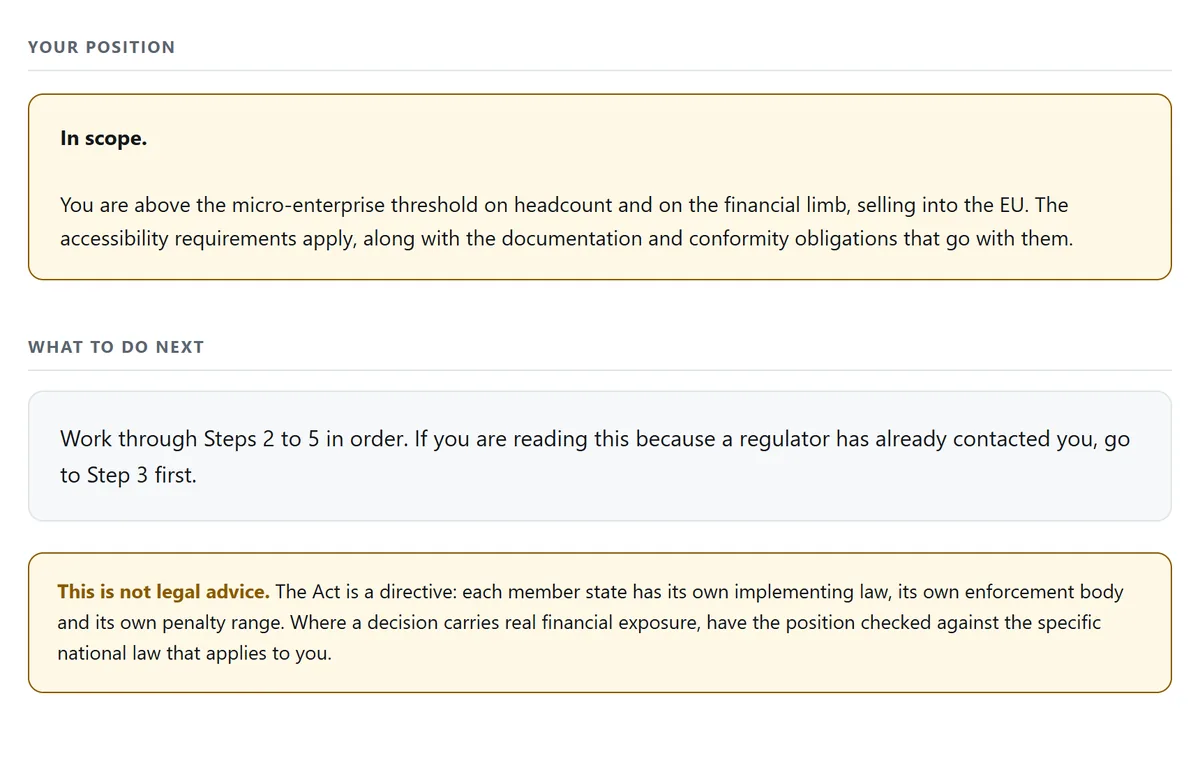
Four questions covering the full category list, products versus services, and the micro-enterprise exemption done properly. That exemption only covers services — most online summaries get it wrong.
STEP 3
Your accessibility statement, written for you
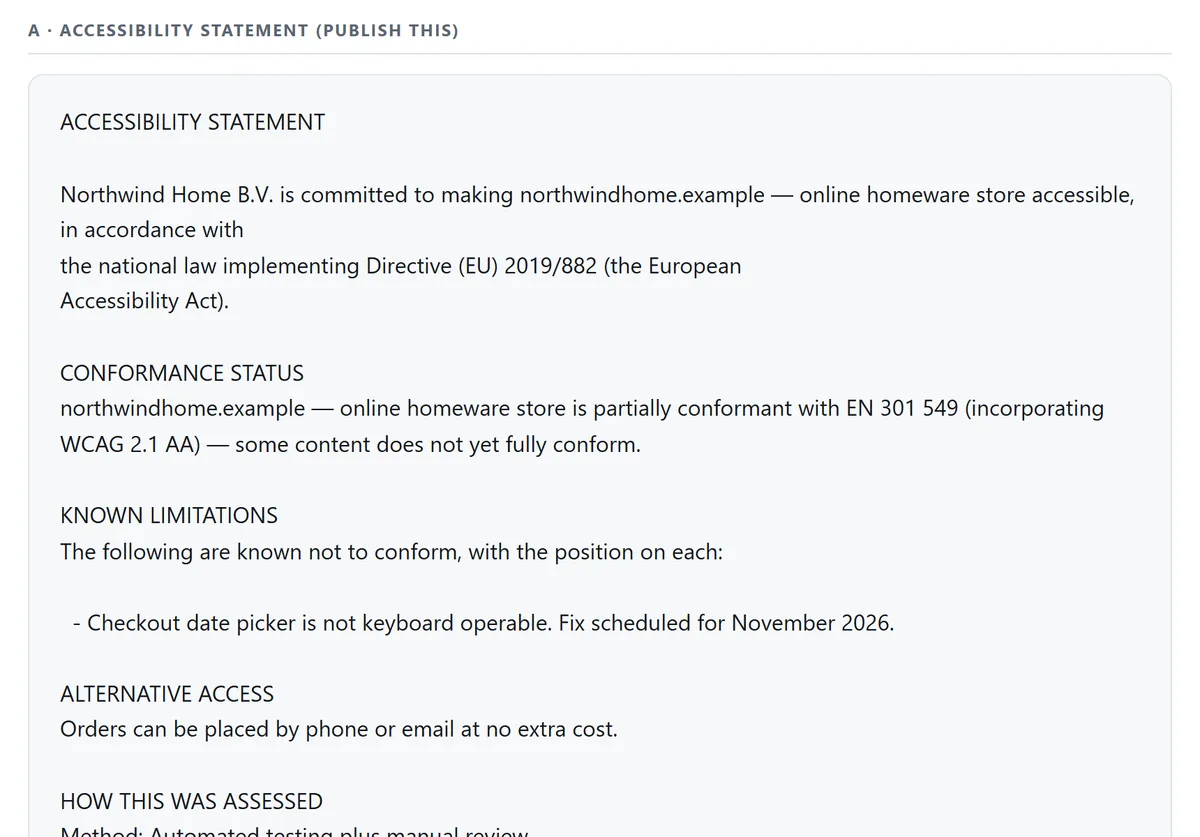
Fill in your details and it writes the Article 13 accessibility statement you publish, plus the internal conformity record you keep on file — the documents a market surveillance authority asks for first.
STEP 5
Annex VI disproportionate-burden assessment
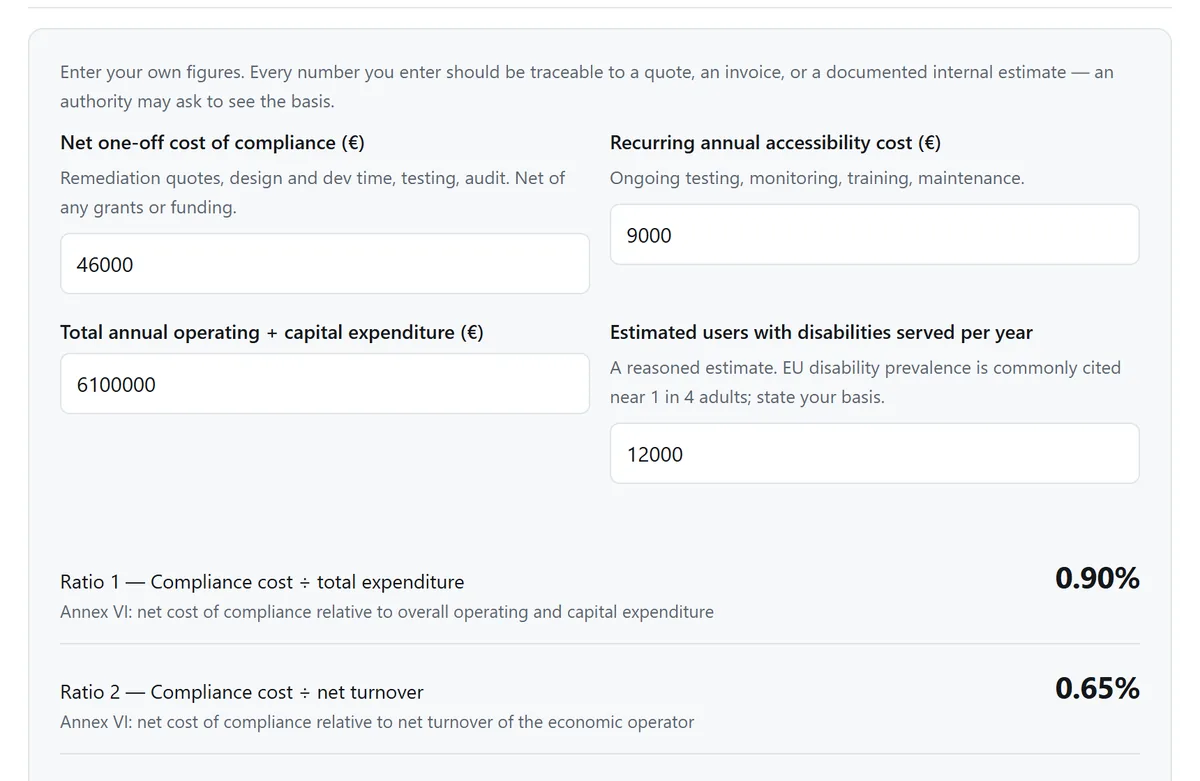
If full compliance would be a disproportionate burden, you can only rely on that if the assessment is documented. Enter your figures; it calculates the ratios and produces the record.
STEP 2
What "accessible" actually means
The Act never names a technical standard. This bridges it to EN 301 549 and WCAG 2.1 AA — then narrows it to the eight failures that most often stop a disabled customer completing a purchase, with a checklist.
STEP 4
If a regulator contacts you
The two routes enforcement arrives by, what has happened to companies so far, and a first-week checklist.
Who it's for
Built for businesses that sell to EU consumers
- Online stores, marketplaces and SaaS businesses
- Businesses outside the EU — US, UK, India and elsewhere — that sell into it
- Small businesses assuming they're exempt. Find out in two minutes.
- Agencies and freelancers building sites for EU clients
How it works
Private by design
- Everything runs on your computer. Nothing you type is uploaded anywhere.
- One small download. Works offline, in any browser.
- No account, no installs, no subscription.
- Free updates as enforcement develops.
Get the kit
Find out where you stand — before a regulator or competitor does.
€99VAT included
- All five tools, instant download
- One payment, no subscription
- Free updates
- 30-day refund if it's not for you
Secure checkout by Dodo Payments.
Questions
Before you buy
Does this make my website compliant?
It tells you where you stand, what the law asks for, and gives you the documents you're expected to have. Fixing the site itself is work for you or your developer — Step 2 shows exactly where to start.
We're not based in the EU. Does it still apply?
If you sell to consumers in the EU, yes — on the same terms as an EU business. Step 1 walks you through it.
We're a small business. Aren't we exempt?
Only if you pass both tests — under 10 staff and under €2m turnover or balance sheet — and only for services. Products stay in scope regardless of size. Step 1 checks this properly.
How do I get it?
Straight after payment you get a download link by email. Unzip it and open index.html in any browser.
Is it legal advice?
No. Every EU country has its own implementing law. If you've already received a formal letter, have your position checked against that country's law as well.
Can I try something first?
Yes — the Annex VI workbook is free to use. The kit adds the other four tools — including the statement generator — and the full process around them.